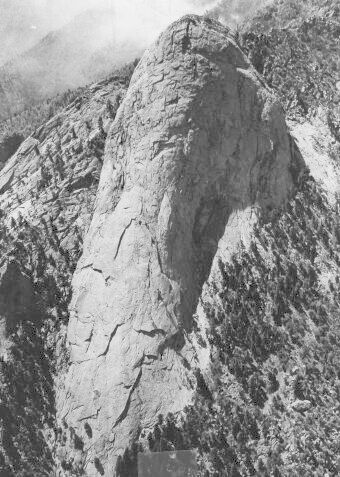
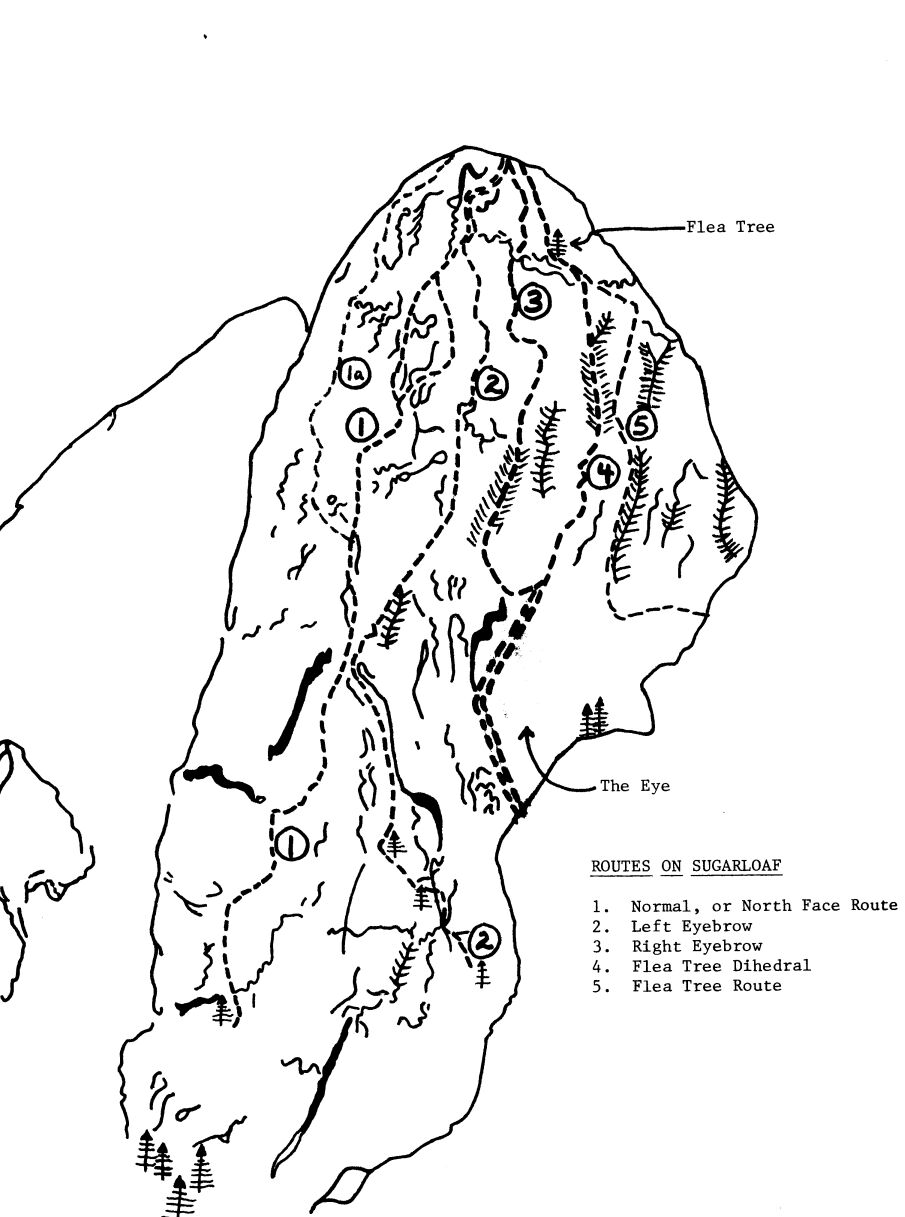
Click for Enlargement Click for Routes
This strange peak, utterly unlike the main Organ peaks, stands in splendid isolation a mile or two to the northeast of the Needle. A cone, or sugarloaf, in form, distinctly white in hue, it is the veritable Glass Mountain of the Andersen fairy tale. The rock is hard and remarkably smooth, with occasional door knob protrusions which proliferate toward the top. It was one of the first technical climbs to be done in the Organs, conquered by the German "paper clip" scientists at White Sands Proving Ground in the far off years of the late forties.
| Principal Routes |
Return to the Top of Sugarloaf Route Descriptions
22a. Normal Route |
|
Class: medium 4 |
4� - 5 hours |
First ascent: 1946(?); H. Schmid, A. Zeiler (?) | |
Pursue the approach for the SE Side of Organ Needle (Route 1f) as far as the low southern continuation of the main Organ Ridge. Turn right and continue east on this ridge until it runs into the transverse ridge joining Sugarloaf and Organ Peak. Turn left and continue on the latter ridge (or preferably below it on the west side) to Sugarloaf. Pass along the right (east) side of the peak to a narrow high saddle northeast of it. Then drop down the gully beyond for a few hundred feet to the foot of a shallow broken up depression on the NE Side. This ends the long approach. Climb up this shallow depression for one pitch, which places you on the smooth N Side of Sugarloaf. Traverse across this face for 100 feet, then bear directly up to the summit along a good crack and ledge system.
To descend, head down the E Side of this dome until a rappel piton is discovered just about where a belay begins to be necessary. One aery 120 foot rappel lands you on a small shoulder, whence another 30 foot rappel takes you to the NE Saddle.
Return to the Top of Sugarloaf Route Descriptions
22b. Direct NE Side |
|
Class: medium 5 and 6 |
5� - 6 hours |
First ascent: 29 July 1956; R. Hahn, G. Scithers, B. Martin | |
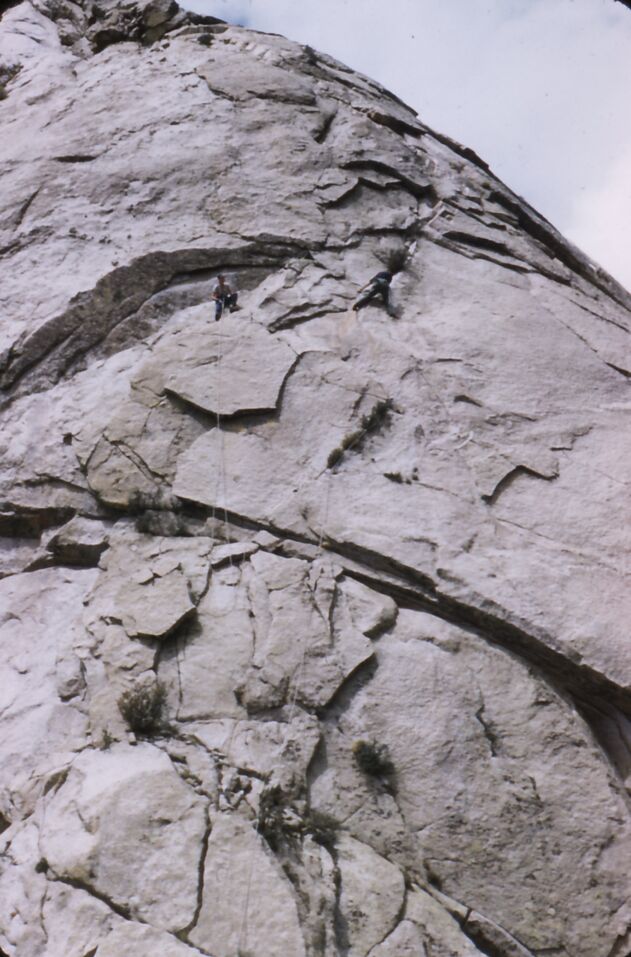
From the NE Saddle climb to the "small shoulder" (see Route 22a), then mount by crack systems in very steep rock with some excellent holds. Toward the summit bear right and emerge onto the N Side slightly below the top.
Return to the Top of Sugarloaf Route Descriptions
22c. N Side |
|
Class: medium 5 |
7� - 8� hours |
First ascent: summer 1960 (?); P. Wohlt, J. France. | |
This route seizes the imagination by its singular beauty. A white ramp, apparently as smooth as glass, rising at an ever increasing angle into the sky for almost 2000 feet. This climb is quite unlike any other in the Organs. Approach as in Route 22a, but arrived at Sugarloaf, drop down alongside either the east or west sides of the peak to the bottom of the N Face. Or, hike to this spot from the Missile Range complex. Get onto this Face as near the bottom as possible. At the beginning, this is friction climbing par excellence. Head up the middle of the Face using the characteristic small protrusions wherever possible. One climbs from one infrequent piton crack to another, bearing gradually left. Security for the leader is difficult to obtain here. After many pitches one rejoins the Normal Route (22a) near the top.
Begin from the "tree" (whichever tree that is: it is to the left of center and is not the highest one (one on the right is higher). There is a trampled cactus and other human signs. Maybe someone will donate a sling to mark this tree. The first pitch goes up a smooth slab with a shallow crack to a fixed angle under a small step. Continue up and left to a broken section which is a full 150 feet away. Belay here. The second pitch goes radically back right on a shallow ledge which is extremely easy. You will reach a grassy ledge. Belay here even though you think you can reach the next big ledge. You probably can't. Either do a short pitch to the next ledge or prepare for an awkward belay and a short pitch later on. The short pitch is recommended. This takes you to a spacious belay where a rib-crack system starts up to a very steep wall. Notice that this wall forms a vee with the right wall leading to smooth faces above, whereas the left wall leads up into a bushy crack. You want to get to the bushy crack. The third full pitch (not counting the last short pitch) goes up the crack and belays at the point of the vee in the steep wall. The stance is on knobs and there is not too much room. The 4th pitch proceeds left up to the prominent bush. From the 3rd belay instead of following the crack next to the wall it is easier to climb out on the face to the left although no protection is available then. The 5th pitch leads up the gully until one can move out onto the face to the right. You should be in a shallow trough-like structure which turns into a thin ledge. Head up to deep sickle shaped crack and belay from ledges here. Off to your right (west) is a smooth face broken by a vertical rib. You should be more or less even with the bottom of the rib for your belay in the deep crack. You want to traverse right hitting the top of the rib and continuing past it. However, you cannot reach the next belay from the deep crack. You now climb straight up for a short pitch to a small, crumbly ledge, more or less even with the top of the rib on the right. Belay here. The 7th pitch (commonly called the "traverse" or "friction" pitch) leads straight over to the top of the rib. Then head up and right across a long face until you can see another vertical rib with a cruddy crack with bushes along it. Head for the base of this. On top of the rib is a bolt for a belay. This pitch is long (150 feet) and relatively unprotected. For the 8th pitch, use the convenient knobs on top of the rib to get on top of the rib and into a fine crack which is followed as far as possible aiming for a large tree (150 feet). You may or may not reach the tree. But any of the now numerous cracks will serve for belays. The 9th pitch heads up and left (the "Eyebrow" Escape joins this route just above the 8th pitch belay) past large bouldery ledges and heads for a distinctively low angle area. A full 150 foot plus lead takes you to the belay on the ledges of the low angle area. At this point one can "escape" from the standard route. Head to the left up the fairly obvious broken "gully". This is quite rotten. About 3 pitches up on this "escape", it is possible to rappel off using a bolt that has been left for that purpose. Don't try rappeling any lower down or you won't make it. If one continues past this rappel it is possible to make the top in about 2-3 pitches. The rappel site is on the "tourist" route up.
To continue on the standard north face route from the top of the 9th pitch, move to the right for the 10th and 11th pitches. The crux pitch of the route, the 12th is now before you. Head up a groove towards a small bush in the middle of the groove. Upon reaching the bush, traverse to the left with a large step and then go straight up 50 feet to the overhang and work through this at its apex; the move seems a lot harder than it really is. Go up another 30 feet or so to a belay position. The thirteenth pitch angles to the left and runs out about 120 feet to any of several belay positions. If one goes right, the difficulty is much greater, although the 13th is quite easy otherwise. The 14th pitch now angles to the right under a quite distinctive series of overhangs, works to the right of a right-facing dihedral and then moves to the left and up over this dihedral with an excellent bollard for a swing up move. One then goes left 15 feet or so and ties into a very large bollard. The 15th pitch can go straight up or directly right and up. Straight up is the more usual way, just go for two more pitches of easy 5th and one of 4th class scrambling to the top. If one goes to the right, one has an amusing 120' unprotected lead of mid 5th small-hold climbing. The next two pitches after this merely angle on to the top.
Return to the Top of Sugarloaf Route Descriptions
22d. Left Eyebrow 5.6 |
|
Class: 5.6 |
? hours |
First ascent: (?) | |
The route begins on the right (west) side of the N. Face about half way between the very bottom and the Eye. There is a well-defined roof above which a sparse collection of trees grows out of the rock. First Pitch: Take to a steep slab and climb up in a dihedral about 50', at which point you can climb out of the dihedral and onto the slabs of the main face proper. Belay from a fine, welcome little tree. Second Pitch: Up a fine crack about 60' to a large tree. Third Pitch: A long wide crack mounts the steep slab above. Takes bongs or angles. Jam up this crack or face climb around it until you run out the rope. This pitch can also be protected very nicely with nuts. Fourth Pitch: Follow the terminating crack up to easy ground, a spacious ledge running across the whole North Face more or less. Fifth Pitch: Traverse over 3rd class ground up and to the right, passing by a healthy tree, to a perch which looks down into the Eye and the uninviting angle of the Right Eyebrow Route. Above is a pitch of rotten rock. Sixth Pitch: Traverse left on some shaky footholds on steep rotten slabs, using good handholds at the top. Heave a sigh of relief, then proceed upward on easier but loose rock to the belay behind a gnarled old veteran of a tree. Seventh Pitch: Follow this deeply incised groove (a prominent feature of the North Face, visible from the cars) to where it gives out in a little roof. Step up, around, and onto the face to the right courtesy of a providential little ramp. Mount 30' over some steep steps to a gracious ledge. Move right, over the Eye, and up over perfect rock with just enough holds and no pin protection, to the belay bolt. Relax, and enjoy some of the most exhilarating exposure in all the Organs. Eighth Pitch: Follow a shallow crack up and slightly right about 40' to where it terminates in a vertical bit. This is probably the crux, in a remarkably even climb. Go straight up here at the apex, then move slightly left and up over very steep rock with marvelous solid holds, running out the rope. Ninth Pitch: The angle slacks off and one can go up almost anywhere, heading for the summit. At the end of this pitch, or perhaps one more, the slope turns 3rd class. Scamper to the summit.
Return to the Top of Sugarloaf Route Descriptions
22e. Right Eyebrow 5.6 |
|
Class: 5.6 |
? hours |
First ascent: (?) | |
Seizes the imagination by the audacity of its line. Slog up the right side of the N. Face, up into the Eye, and don iron at a central tree. First Pitch: Climb around the right edge of the Eye and up to a comfortable ledge about 120'. Watch the loose rock! The Eye is beneath and to your left as you hopelessly scan the soaring slabs above. Second Pitch: Slide down and tippy-toe across a fine tiny ledge just over the Eye. Then mount up over some steep little problems to a fine belay standing behind a giant flake. This pitch is indirect and runs out about 100' of rope. If you have reached the right perch, the great steep ramp-dihedral (a prominent groove visible from afar) begins where you are and mounts directly overhead. To the left of it are the vertical slabs directly over the Eye. A possible mistake on this pitch is to head for another prominent groove system directly over the belay spot at the end of the first pitch. Third Pitch: Run out the rope up the steep ramp. Rock is a bit rotten and pin protection must be searched for. One can actually get about 3 good pins in on this stretch. Staying on small holds on the ramp is usually best, with an occasional layback move in the dihedral. If your rope is long enough (165') you reach a belay bolt just above a hardy bush. Fourth Pitch: Continue up the ramp where it steepens and terminates some 40' above. Best technique here is to ease across the slab into the very dihedral itself at the top and layback out of it. Then continue over a steep sloping ledge and up an easy crack to a spacious gouged out place. (This takes about 165'; if your rope is 150', nail in a belay at the bottom of the easy crack and make the short bit to the gouged area an extra pitch.) Fifth Pitch: Traverse left out of the gouge and around the corner onto vertical rock. Perfect holds - another beautiful airy high spot. Climb up a little dihedral to the top of a little buttress, then work left some 15' and then up. A good belay spot is reached at about rope's end. This pitch is especially beautiful since it clings to the steepest part of the upper face directly over the Eye. Sixth Pitch: Mount easy 5th about 100' to a small roof system which is turned by a delicate step or two at its right end. The belay spot is shortly above. The Flea Tree is visible at about this level 150' to the right. Seventh Pitch: 4th class to easy summit ground. Then unrope and waltz to the summit. (Note added 1985: a massive rock fall several years ago has much altered the end of the fourth and the whole fifth pitch.)
Return to the Top of Sugarloaf Route Descriptions
22f. Flea Tree Dihedral 5.7 |
|
Class: 5.7 |
? hours |
First ascent: (?) | |
Approach as for the Right Eyebrow. First Pitch: as in the Right Eyebrow, climb around the right edge of the Eye and up to a comfortable ledge. Second Pitch: mount right and slightly upward on 3rd and 4th class rock, running out the rope. This puts you about 40 feet beneath a striking triangular slab with slanting dihedrals forming the top two sides. This is the bit, which, when viewed from around the N. Face camp, causes much head shaking. It is steep, but not as steep as it looked from there. Third Pitch, the crux: climb up to the base of the triangle slab and get a good pin (a bong) as high up as possible in the right hand dihedral. Then levitate upward and to the left on small holds, to a few good holds in the left dihedral. Move back right to the apex of the triangle and step up onto an airy knob. Now the upper part of the pitch can be seen; a steep crack running straight up and a steep slabby face to the right. Traverse right about 8-10' on a good tiny ledge which then disappears. Mantle up and over into a good stance and move back left to the crack again. Mount on easier rock to the belay spot on top of a giant flake about 20' up and to the left. Do not place an angle behind it - as big as it is, it moves and groans! And the whole party is directly below. A terrific nut crack is discovered just above it. Fourth Pitch: the upper part of the dihedral, now easy, is quickly disposed of, placing you beneath a small bare patch of wall. Simply ooze up and right and then back leftward on classic familiar Organ friction climbing. The angle eases off and you romp toward the Flea Tree. Belay somewhere below it, or perhaps even reach it. Sixth Pitch: after making the acquaintance of the fabulous Flea Tree, mount directly over it on steep slabs with disgracefully good holds to level ground just below and west of the summit. Unrope and march to the summit.
Return to the Top of Sugarloaf Route Descriptions
Descent from Sugarloaf |
From the top, descend 150-200 feet to the east until you find the rather obvious rappel position, which is three fixed pins. If you have two 150 foot ropes, you can get down in two rappels, The first drops about 140 feet to a large ledge where there are fixed pins, and a second 40 foot rappel will get you to the ground at the notch. If you have but a 150 or 165 foot rope, double it and handline or rappel down about 70 feet to a niche of sorts where one will find two bolts; a second rappel will get you to the large ledge mentioned above. Upon gaining the notch, descend down the north facing gully for a few hundred feet (until the going gets sticky) and then head right (east) and work down to the "Saddle".
Return to the Top of Sugarloaf Route Descriptions
Approach From the North |
This is putting first things last. Drive in on the Aguirre Springs road and go around the loop 3/4 of the way, to the SE corner. A small "pass" will be seen about 1/2 mile away, which frames Sugarloaf. Walk over the low point of this "pass" where a "trail" will be found. Head more or less towards Sugarloaf until you get into the farthest east streambed, which comes from Indian Hollow. If you're headed to the E. Slabs, head for the "Saddle" which is the noticeably level spot on the ridge which heads E. from Sugarloaf. Upon reaching the "Saddle" drop down about a hundred feet diagonally and then pretty much maintain your elevation until you reach the Slabs; that is, you have dropped over to the S. side of the "Saddle". If headed to the N. Face from here, diagonal to the W, along the N. Slope for 1/2 mile or so until reaching the base of the face.