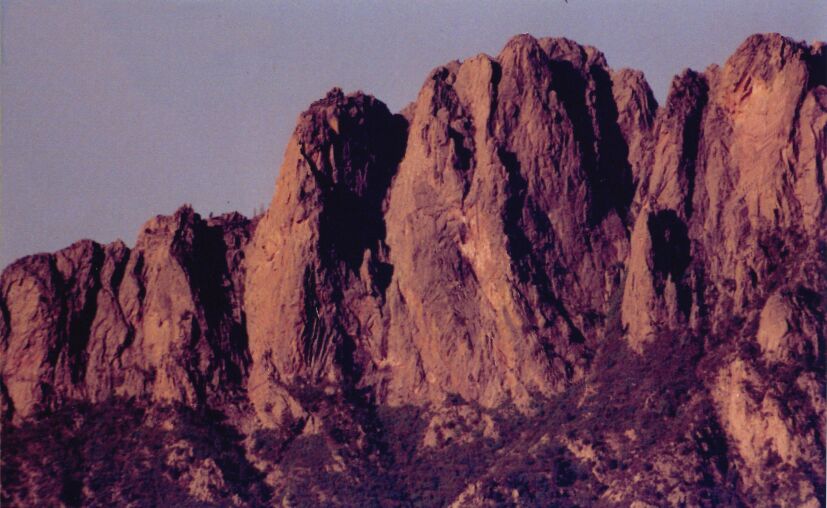
The Needle is the high point of the Organ Range, a trifle over 9000 feet high, and marks the southern terminus of the climbing rock. Seen from the west it is (in spite of the name) a broad, blunt tower, bracketed by what appear to be two subsidiary towers, like ears.
From the east, it forms one end of an impressive rampart of gray rock over a mile long and well over 1000 feet high - the great East Faces. It was climbed already in "ancient" times; there is the record of an ascent in 1903 by two students from the then A. and M. College but no one knows whether it was not climbed earlier. The Needle is one of the very few Organ peaks climbed earlier than about 20 years ago, first because it is one of the few major peaks provided with a walk-up route and second, because the Organs have always had the reputation of being "inaccessible", as a talk with any of the local townspeople will reveal.
| Principal Routes |
| 1a. Normal Route | |
| Class: 3 | 3½ - 4 hours |
| First ascent: ? | |
 Starting from the Cuevas, pursue the Wedge approach (see
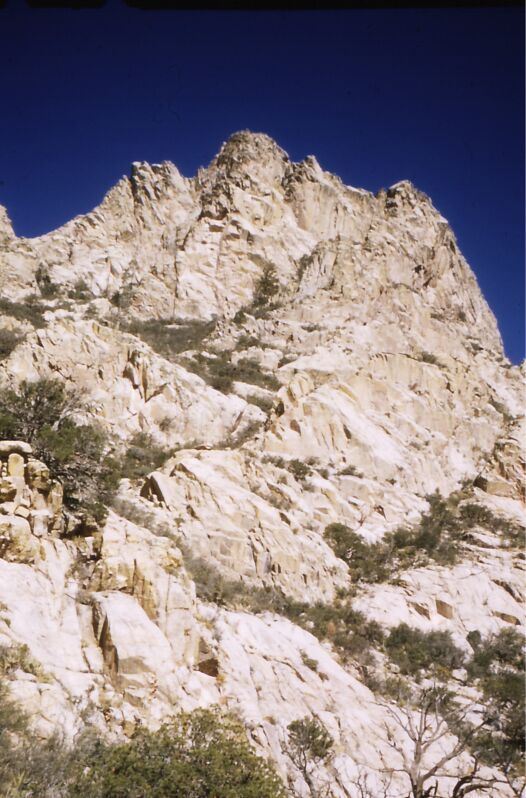
Route 4a) as far as the point 30 yards beyond the gate in the old fence, where the Wedge approach turns north. Continue along the right bank of Fillmore Canyon for 1/2 mile, then strike uphill to a prominent outcropping of white-orange rocks (the Yellow Rocks). Mount the arroyo to the right for 300 yards, then bushwhack up the slope to the south, following a dry watercourse full of smoothed boulders, to the base of the Grey Eminence, a large rhyolite shoulder projecting out of the lower part of the west side of the Needle. Follow a good trail, which hugs the base of this rock, all the way to the saddle above it, which is graced with several large junipers. Then continue straight up the west side, keeping to the boulder-filled dry watercourse, which is relatively free of brush, and to deer trails above this. (Always take a deer trail, where possible, in the Organs, which is what is meant by the Organ maxim, "Think like a deer!") A small rock wall just above the juniper saddle is turned on the right. About 50 yards from the base of the summit tower of the Needle turn right into a narrow canyon (Dark Canyon), which runs between the summit tower and a curving, narrow wall several hundred feet high (the Retaining Wall). (Caution: if the right turn is made too soon, into a similar canyon lower down, the Retaining Wall bars access to the summit.) Continue up Dark Canyon to a narrow saddle on the Organ Ridge. Take to the rocks on your left and climb up an easy 3rd Class gully, somewhat exposed, on the south side of the summit tower to the summit. Or, drop over the saddle into a brushy gully and essentially walk up an easier route on the southeast side. (The latter was probably the route of the "pre-historic" ascents.)
Starting from the Cuevas, pursue the Wedge approach (see
Route 4a) as far as the point 30 yards beyond the gate in the old fence, where the Wedge approach turns north. Continue along the right bank of Fillmore Canyon for 1/2 mile, then strike uphill to a prominent outcropping of white-orange rocks (the Yellow Rocks). Mount the arroyo to the right for 300 yards, then bushwhack up the slope to the south, following a dry watercourse full of smoothed boulders, to the base of the Grey Eminence, a large rhyolite shoulder projecting out of the lower part of the west side of the Needle. Follow a good trail, which hugs the base of this rock, all the way to the saddle above it, which is graced with several large junipers. Then continue straight up the west side, keeping to the boulder-filled dry watercourse, which is relatively free of brush, and to deer trails above this. (Always take a deer trail, where possible, in the Organs, which is what is meant by the Organ maxim, "Think like a deer!") A small rock wall just above the juniper saddle is turned on the right. About 50 yards from the base of the summit tower of the Needle turn right into a narrow canyon (Dark Canyon), which runs between the summit tower and a curving, narrow wall several hundred feet high (the Retaining Wall). (Caution: if the right turn is made too soon, into a similar canyon lower down, the Retaining Wall bars access to the summit.) Continue up Dark Canyon to a narrow saddle on the Organ Ridge. Take to the rocks on your left and climb up an easy 3rd Class gully, somewhat exposed, on the south side of the summit tower to the summit. Or, drop over the saddle into a brushy gully and essentially walk up an easier route on the southeast side. (The latter was probably the route of the "pre-historic" ascents.)
Return by retracing the approach route.
Return to the Top of Organ Needle Route Descriptions
| 1b. SW Wall | |
| Class: 5 | 4½ - 5 hours |
| First ascent: 31 March 1963; R. Ingraham G. Goedecke, R. Thomas, P. Bennett | |
Return to the Top of Organ Needle Route Descriptions
| 1c. The Retaining Wall | |
| Class: 3 | 3¼ - 4 hours |
| First ascent: ? | |
Return to the Top of Organ Needle Route Descriptions
| 1d. NW Ridge | |
| Class: medium 5 | 4½ - 5 hours |
| First ascent: P. Rogowski, and others | |
Return to the Top of Organ Needle Route Descriptions
| 1e. NE Face, Marathon Route | |
| Class: medium 4 | 6½ - 7 hours |
| First ascent: 3 April 1960; P. Wohlt and R. Ingraham | |
As seen best from due east, say, the Missile Range Base, the E Face of the Needle is divided into two parts: the southern part is indented, impressively vertical, and sports a great black spot about halfway up; the northern half is really northeast facing and forms a great sweeping ramp whose angle ever increases as it rises. The line of demarcation of these two halves is thus a long, curving pseudo-ridge. The route goes more or less up this "ridge". After about 500 feet of elevation a point is reached from which you can look out onto the true E Face at the level of the Black Spot. (Although the E Face has been assaulted several times, it has not been climbed to date and remains one of the "three last problems" of the Organs.) Continue up the "ridge" until the two faces merge into one; there is a tower here and a blade of rock continuing upward. Keep to the right of this blade (to the left is just a walk up a very brushy gully) and climb some slabs and small open chimneys. You eventually emerge through a narrow gap onto the summit plateau of the Needle with Buzzard Peak, a subsidiary summit, immediately on your right. Walk to the western, proper summit.
Return to the Top of Organ Needle Route Descriptions
| 1f. SE Side | |
| Class: 3 | 4½ - 5 hours |
| First ascent: Spring 1964; R. Ingraham and E. Redford | |
Return to the Top of Organ Needle Route Descriptions
| 1g. Minerva's Temple | |
| Class: medium 5 | 5½ - 6 hours |
| First ascent: Date unknown; Yale Mountaineering Club | |